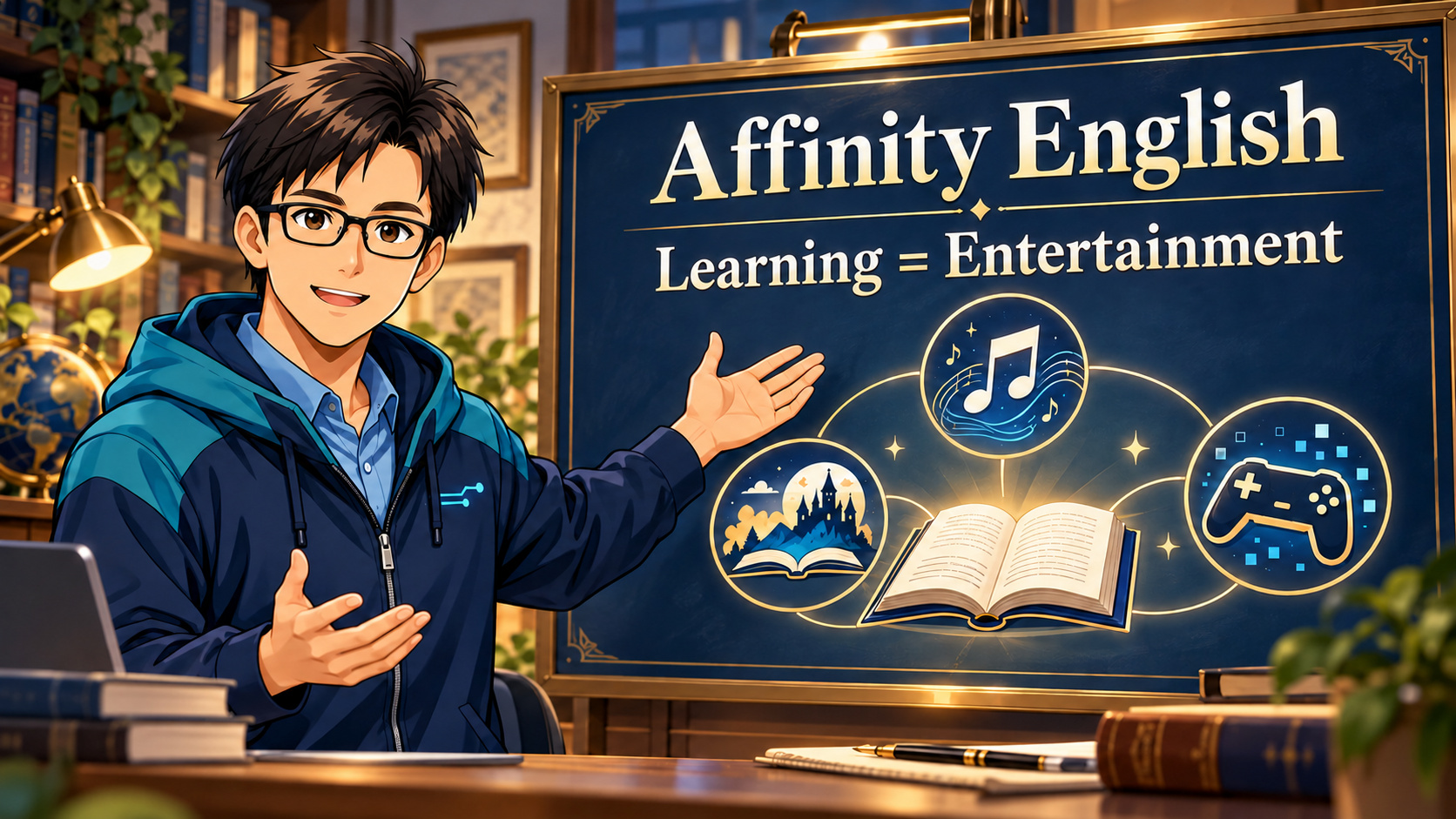
WILESTARS applies Affinity English, the original teaching method created by Manabu Tokimoto.
An interest in a world. A reason to understand its English.
Wanting to know what happens next. Wanting to understand a song. Wanting to try again with characters you like. WILESTARS brings those feelings together with the experience of understanding English and cybersecurity through Affinity English.
From Manabu Tokimoto's experience and original teaching method to learning that connects enjoyment with understanding. Select the image to enlarge it.
INTEREST, UNDERSTANDING AND THE DESIRE TO CONTINUE
A personal reason to want to understand.
Affinity English is an original teaching method developed by Manabu Tokimoto through his experience teaching English. It connects a learner’s interests, current difficulties, desired changes and feelings about learning to design experiences they can enjoy and continue at a manageable pace.
Understanding a favorite player’s words. Reading the next part of a story for yourself. Using English at work with a clear sense of its meaning. The starting point is to connect something meaningful to the learner with explanations and experiences that help them understand it.
This includes people who already enjoy English, adults returning to it, and people who need it but feel discouraged. Their interests and the feeling of “I can understand this” matter together.
CONNECT AN INTEREST WITH AN EXPERIENCE OF UNDERSTANDING
Think beyond the topic to how this person can engage with it.
Affinity English goes further than adding a favorite topic to a lesson. What does this person want to know? Where does understanding stop? What do they want to do in English? When do they lose confidence? Those connections inform the topic, explanation, difficulty and amount of work.
For someone who likes English, an experience can deepen an existing interest. For an adult who has been away from English, or feels anxious despite needing it, the starting point may be understanding something they care about. The learner’s present experience leads toward what they want to discover next.
The learner’s present experience Connect enjoyment and understanding
InterestsPeople, stories, work and music
Current difficultiesVocabulary, grammar, listening and workload
Desired changesWanting to read, communicate and use English
Feelings about learningConfidence, anxiety and a sense of achievement
Figure 1. These concerns interact at the same time; they are not a fixed sequence to complete in order.
FOR EXAMPLE: AN ADULT WHO LOVES SOCCER
From “memorize this grammar” to “I want to understand my favorite player.”
Connecting the same grammar with a player’s interview or a situation in a match gives the learner a reason to understand it. Explain unfamiliar words and begin with a manageable length. Use an expression to give an opinion, then encounter it again in another setting. Interest and understanding support the next attempt.
In a group lesson, this does not mean everyone must share the same hobby. Work, sport and stories can offer different ways in. WILESTARS develops those possibilities within a shared world.
FROM TEACHING METHOD TO CREATIVE WORK
English × Cybersecurity × The world of WILESTARS
Manabu Tokimoto's method→Enjoy WILESTARS with Mana and friends: Stories · Character encyclopedia · Games · Music
WILESTARS brings this approach together with Tokimoto's experience in cybersecurity through stories told as novels, comics and anime, a character encyclopedia, games and music. Conversation-based learning books also connect with these experiences.
Understanding an English sentence can help a reader understand a character’s feelings or a safer decision. Characters and words encountered in a story can be enjoyed again in another work. Learning opportunities are built into the experiences and their connections.
“I want to know more about this world.” That feeling becomes a reason to return to English.Start with what interests you, then follow what you want to discover. Readers choose how to enjoy the world.
AFFINITY ENGLISH IN PRACTICEA shared world, characters, words and decisions
Understand more through one experience, then encounter familiar ideas in another.
StoriesNovels · Comics · AnimeFollow events and feelings
Character encyclopediaConnect a character with an English term
GamesChoose, explore the reason and use what you learn
MusicTurn wanting to listen into wanting to understand
Figure 2. There is no requirement to experience everything in order. Familiarity with the world can support understanding in the work a reader chooses.
EXPERIENCE AFFINITY ENGLISH IN WILESTARS
Learning within the enjoyment.
Follow a story, read lyrics, get to know a companion or think through a question. Begin with what interests you. Enjoyment and understanding can carry across to another experience in the same world.
STORIES (NOVELS, COMICS AND ANIME)
Wanting to know what happens next can become wanting to read it in English.
Enjoy the expressions and events you encountered in Mana’s comic through an English story and narration. Episode 01, “The Sender’s Shadow,” follows familiar-looking senders and messages that demand urgent action. The English meaning and the question of what to check unfold together.
Pictures, text, voices and captions provide ways to understand the same original story while continuing to enjoy it.
A favorite companion can help bring an English term to mind.
Character names connect with English cybersecurity terms, such as Phishingon and phishing. Their appearances and individual comics lead into meanings, example sentences and questions showing when those words are used.
Meeting the same companions in a story or game creates another opportunity to encounter familiar words and ideas.
A song you like can become a song you want to understand.
Enjoy Mana’s songs and explore their English lyrics. “Before You Click” invites listeners to notice senders, links and urgent language, then think about decisions before clicking through related questions.
The opening song, “Side by Side, We Find the Way,” connects listeners with the story and companions. Enjoying a song and discovering the meaning of its English can become one experience.
Challenge together, explore “why,” and return to the game.
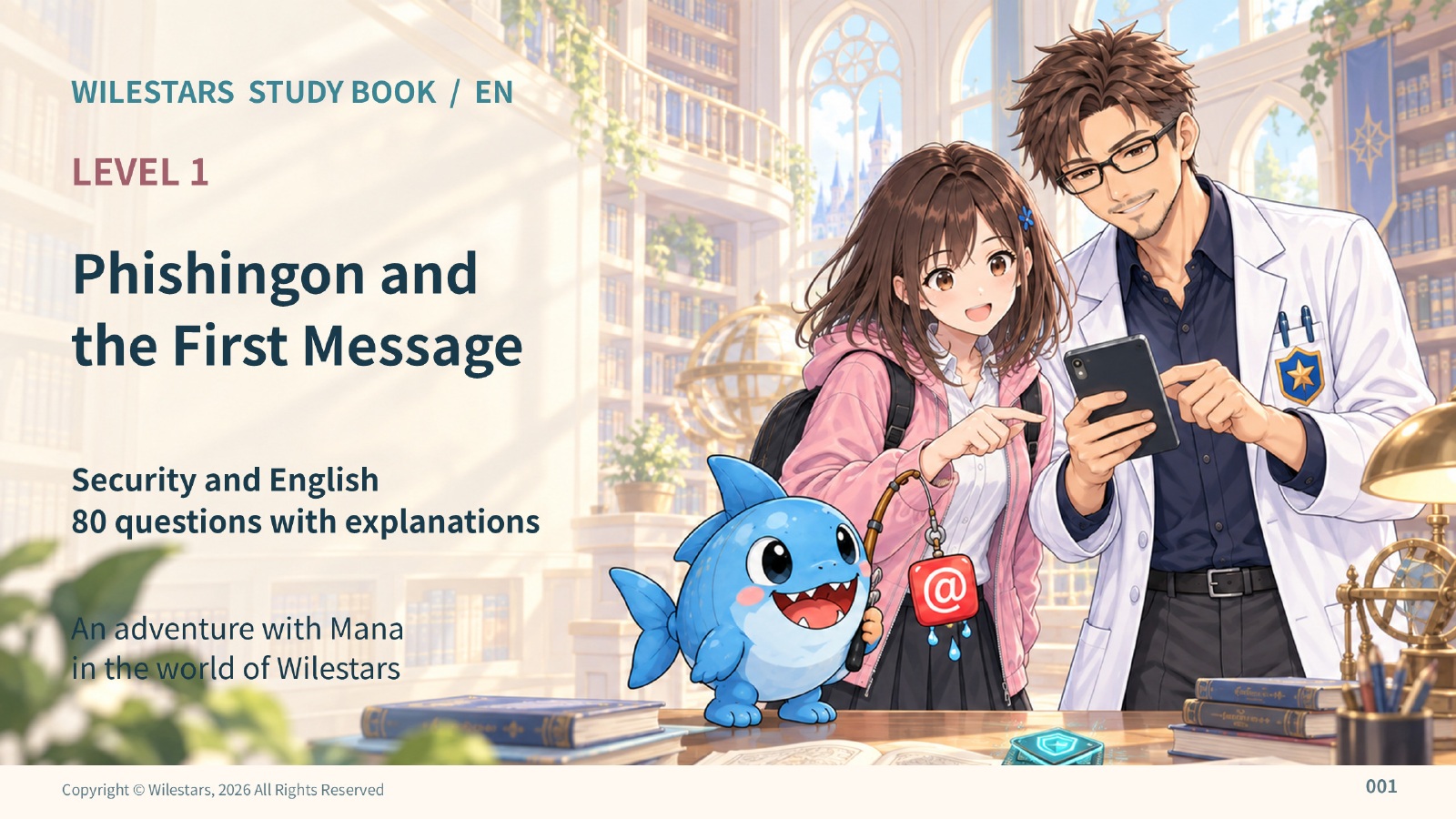
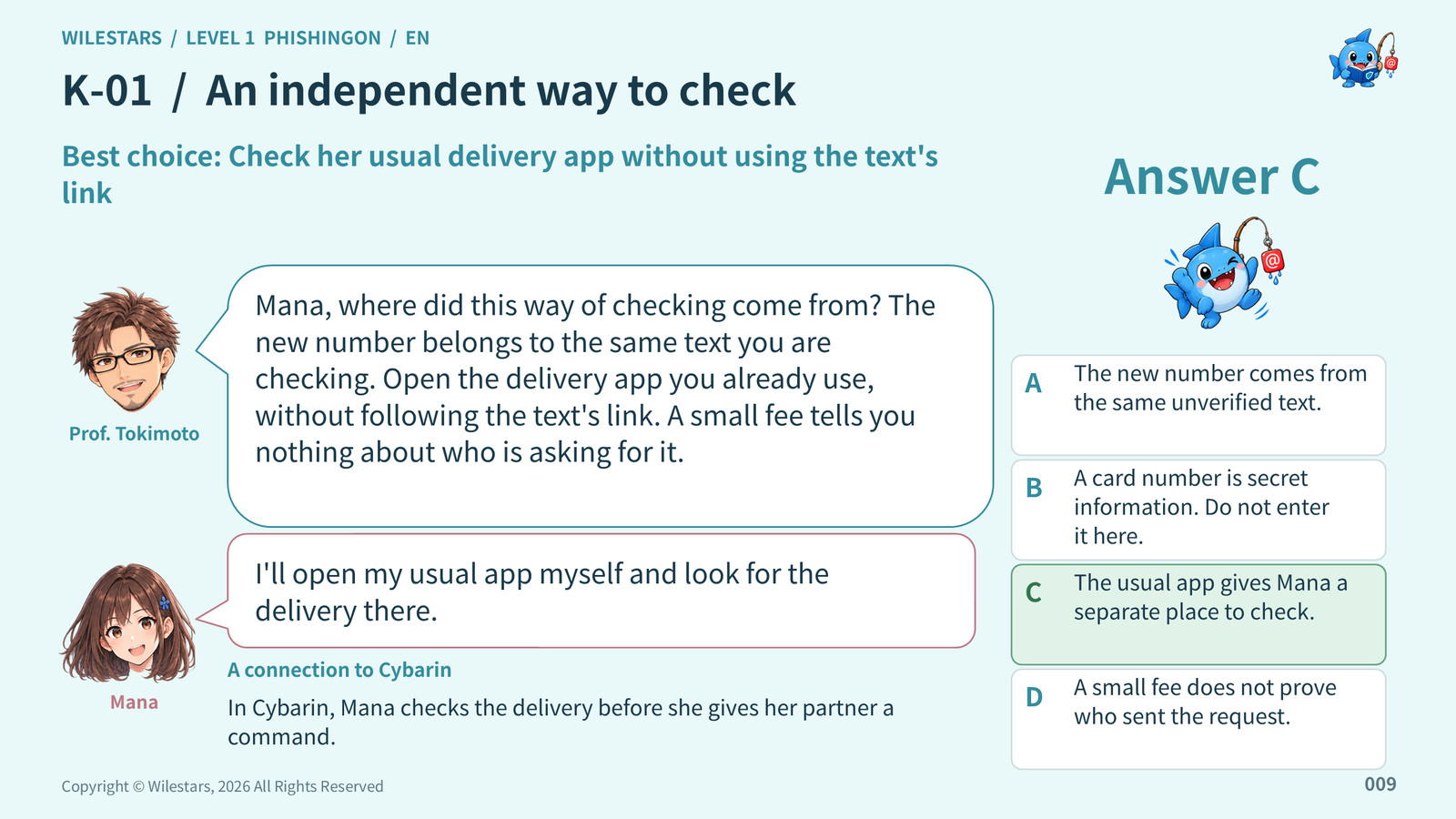
In the RPG, answer English and cybersecurity questions while choosing companions and skills. For a question you want to understand better, the corresponding learning book uses conversations with Mana, Dr. Tokimoto and others to explain why an answer is correct and how the alternatives differ.
The game and books use corresponding questions. Understanding the reasons supports the enjoyment of applying them in another attempt.
All 21 English story episodes are available free. Enjoy them with illustrations and narration. The desire to know more, sparked by a comic or song, becomes an opportunity to keep encountering English.
What research tells us about sustaining interest and understanding.
Tokimoto developed Affinity English through his experience teaching English. The studies below concern motivation, second-language learning, memory and learning with media. Their conditions help explain how related ideas inform particular WILESTARS experiences.
The figures below describe the learners, materials and experiments in the cited studies. They are not measured results for Affinity English or WILESTARS as a whole. d and g are standardized effect sizes; r is a correlation coefficient. They are not percentages of improvement or success rates.
CONNECT RESEARCH FINDINGS WITH THE DESIGN
From interest to understanding and the desire to continue.
A reason to care, a clue that makes meaning clearer, and an opportunity to return. Explore those connections through the original studies and the examples below.
These are results from the cited studies, not measurements of Affinity English or WILESTARS as a whole. d and g are standardized effect sizes, not percentages of improvement.
01
“This interests me” and “this matters to me” can support continued learning.
EXAMPLE FROM WILESTARS
Mana and a reason to know more
344samples
Motivation and outcomes across 223,209 students. [1]
144studies
Conditions supporting motivation, with over 79,000 students. [2]
262students
A high-school science intervention connecting course content with students’ lives. [3]
Howard and colleagues found that intrinsic interest in learning was associated with academic success and well-being. Personally valuing what is learned showed a particularly strong association with persistence. Bureau and colleagues examined how competence, autonomy and relatedness connect with autonomous motivation. [1][2]
In high-school science, writing about the relevance of course content to one’s own life supported interest and performance among students with low expectations of success. This connects with choosing meaningful topics while also providing support for understanding. The science-class results are not direct estimates for an English-learning product. [3]
In WILESTARSAn interest in a character, song, story or safer decision becomes an entry point. Pictures and explanations support repeated experiences of making sense of the content.
02
Enjoying an ongoing story creates more opportunities to encounter English.
EXAMPLE FROM WILESTARS
The same story, in English too
73studies
2025 extensive-reading meta-analysis: 82 interventions and 86 comparisons. [4]
d = 0.41
Overall effect; d = 0.38 for 82 immediate comparisons. [4]
3,942participants
34 studies in the 2015 analysis; d = 0.46 in control-group comparisons. [5]
Extensive-reading research connects sustained reading of understandable texts with reading comprehension, vocabulary and fluency. Many interventions in the 2025 analysis involved English, and many comparisons involved university students. Difficulty, text selection and how learners engage with the texts affect the results. [4][5]
Suk’s 15-week study examined comprehension, reading rate and vocabulary among 171 Korean university students. WILESTARS offers 21 free English story episodes, with illustrations and narration, so readers already familiar with its comics or characters can continue exploring in English. [6]
Repeated encounters also matter. Webb compared one, three, seven and ten exposures among 121 learners in Japan. Uchihara and colleagues combined 26 studies with 1,918 participants and found r = 0.34 between repetition and incidental vocabulary learning. Rodgers and Webb analyzed vocabulary in a corpus of 288 television episodes; this was a study of opportunities to encounter words again, rather than a learning intervention. [7][8][9]
In WILESTARSThe same characters and cybersecurity terms appear in stories, the collection, songs and the game. Familiar ideas can provide a foothold for understanding another English expression.
03
Return after a break, recall an idea and use it.
EXAMPLE FROM WILESTARS
Phishingon and phishing
48experiments
Second-language spaced practice: 3,411 participants and 98 effect sizes. [10]
Spacing practice can support later recall compared with massed repetition. The second-language meta-analysis examined the effects of distributed practice and how suitable spacing depends on when retention is tested. [10][11]
In Karpicke and Roediger’s foreign-language vocabulary experiment, continuing to retrieve an answer after an initial correct response supported later retention. A meta-analysis of practice testing also treats answering questions as a learning opportunity, rather than only an assessment. [12][13]
In WILESTARSEncounter a word in the collection or lyrics, then recall it in a game question later. Explore an explanation in a conversation-based book and try again. Returning for enjoyment also creates opportunities to retrieve and use knowledge.
04
Music can connect the desire to listen with words and meaning.
EXAMPLE FROM WILESTARS
From a favorite song to its meaning
2songs
A vocabulary study comparing one, three and five listening occasions. [14]
60adults
A 15-minute comparison of speaking, rhythmic speaking and singing. [15]
Pavia and colleagues examined learning word sounds, form–meaning connections and word combinations through songs. Ludke and colleagues found better memory for foreign-language phrases among adults who practiced by singing than among those who practiced by speaking. This does not mean listening alone produces the same result: the activity and conditions matter. [14][15]
Schön and colleagues used an artificial language to examine how corresponding musical and linguistic regularities can help listeners discover word boundaries. The study informs thinking about connections between sound, lyrics and meaning. [16]
In WILESTARS“Side by Side, We Find the Way” introduces the world and its characters. “Before You Click” connects lyrics with questions about English meaning and safer decisions. Each song’s role helps turn wanting to listen again into wanting to understand.
05
Pictures, voices and English text can help a learner grasp what is happening.
EXAMPLE FROM WILESTARS
Connect appearance, words and meaning
49experiments
Captioned viewing and vocabulary: 89 effect sizes. [17]
g = 0.56
Same-language captions compared with no captions. [17]
103studies
Signaling where to focus attention: 12,201 participants. [21]
The captioned-viewing meta-analysis examines how text in the same language as the audio supports incidental vocabulary learning. Chun and Plass studied textual and pictorial vocabulary annotations; Liu examined conditions in which comics support second-language reading comprehension. Support needs to fit the content and the learner’s English. [17][18][19]
Rey and colleagues examined presenting content in manageable segments across 56 studies and 88 comparisons. Schneider and colleagues analyzed signals directing attention to important information. Ainsworth’s DeFT framework considers how multiple representations complement one another, constrain misinterpretations and support deeper understanding. [20][21][26]
In WILESTARSExpressions, English text and narration offer clues to the same scene. The collection connects a character’s appearance with a term, its meaning and example sentences. The aim is to help readers attend to what they want to understand, rather than simply add more information.
06
Connect what is learned with the choices and purpose of play.
EXAMPLE FROM WILESTARS
Choose together and try again
Habgood and Ainsworth studied educational games with learning integrated into play in two studies with 58 and 16 participants. Their participants were children. The connection here is the design of learning as part of the game’s activity; WILESTARS primarily addresses people interested in English and adults returning to learning. [22]
Clark and colleagues combined 57 studies and 209 effect sizes comparing games with non-game conditions: g = 0.33 (95% CI 0.19–0.48). The learning content, design and comparison conditions matter, not simply whether an activity is a game. Sailer and Homner studied gamification—the addition of game elements to learning processes—and reported cognitive, motivational and behavioral outcomes. [23][24]
RESEARCH DATA 1 · GAMIFICATION META-ANALYSIS
Effects vary with the outcome being measured.
Chart values and research samples
Outcome
g
95% CI
k / N
Cognitive
0.49
0.30–0.69
19 / 1,686
Motivational
0.36
0.18–0.54
16 / 2,246
Behavioral
0.25
0.04–0.46
9 / 951
Source: Sailer & Homner (2020) [24]. k is the number of studies and N the number of participants in each analysis. The samples differ by outcome and should not be added. g = 0.49 does not mean “49% improvement.” In more rigorous studies, the motivational and behavioral findings were less stable than the cognitive findings.
A practical example: learning cybersecurity decisions through choices.
Anti-Phishing Phil is a game about distinguishing legitimate and phishing websites from URLs. Its evaluation compared accuracy before and after up to 15 minutes of learning among 42 non-experts, with 14 people in each of three conditions. It did not test WILESTARS; it provides a concrete earlier example of incorporating a security decision into a game choice. [25]
RESEARCH DATA 2 · ANTI-PHISHING PHIL
Correct identification of legitimate and phishing websites.
The colored portion shows correct identifications; the pale portion shows incorrect answers. All three conditions are shown before and after learning.
Values from Figure 7 of the original paper
Condition
Before
After
Existing materials
66%
74%
Tutorial
65%
80%
Game
69%
87%
Source: Sheng et al. (2007), Figure 7 [25]. Participants judged ten sites in each test. The existing-materials group used data collected five months earlier; all three groups were not randomized together at the same time. The game group’s post-test difference from the existing-materials group was significant (p < .02). These results do not establish the same effects for every material or long-term protection.
In WILESTARSKnowledge, terminology, grammar and reading are part of RPG choices and progression. A question that makes a reader curious can lead to a conversation-based explanation in the corresponding book. The design connects understanding with challenges shared with companions.
EXPLORE THE SOURCES
References and research material
These 26 references relate to interest and persistence, reading, listening, retrieval, and the design of media and games. Links lead to the original publication records. Full-text availability varies by publisher.
[1]
Howard et al. (2021). Student Motivation and Associated Outcomes: A Meta-Analysis From Self-Determination Theory. Perspectives on Psychological Science, 16(6), 1300–1323.
Connection to this page: Intrinsic interest, personal value and persistence.
Bureau et al. (2022). Pathways to Student Motivation: A Meta-Analysis of Antecedents of Autonomous and Controlled Motivations. Review of Educational Research, 92(1), 46–72.
Connection to this page: Competence, autonomy and a learning environment with meaningful choices.
Sangers et al. (2025). Learning a Language Through Reading: A Meta-analysis of Studies on the Effects of Extensive Reading on Second and Foreign Language Learning. Educational Psychology Review, 37, Article 96.
Connection to this page: Choosing understandable texts and reading over time.
Suk (2017). The Effects of Extensive Reading on Reading Comprehension, Reading Rate, and Vocabulary Acquisition. Reading Research Quarterly, 52(1), 73–89.
Connection to this page: Comprehension, reading rate and vocabulary among university students.
Uchihara, Webb & Yanagisawa (2019). The Effects of Repetition on Incidental Vocabulary Learning: A Meta-Analysis of Correlational Studies. Language Learning, 69(3), 559–599.
Connection to this page: Associations between frequency and incidental vocabulary learning.
Adesope, Trevisan & Sundararajan (2017). Rethinking the Use of Tests: A Meta-Analysis of Practice Testing. Review of Educational Research, 87(3), 659–701.
Connection to this page: Using practice questions as an opportunity to learn.
Kurokawa, Hein & Uchihara (2025). Incidental Vocabulary Acquisition Through Captioned Viewing: A Meta-Analysis. Language Learning, 75(4), 939–987 (first published online in 2024).
Connection to this page: Same-language captions and incidental vocabulary learning.
Habgood & Ainsworth (2011). Motivating Children to Learn Effectively: Exploring the Value of Intrinsic Integration in Educational Games. The Journal of the Learning Sciences, 20(2), 169–206.
Connection to this page: Integrating learning into the actions needed to progress in a game.
Clark, Tanner-Smith & Killingsworth (2016). Digital Games, Design, and Learning: A Systematic Review and Meta-Analysis. Review of Educational Research, 86(1), 79–122.
Connection to this page: Digital games, learning effects and design conditions.
Sheng et al. (2007). Anti-Phishing Phil: The Design and Evaluation of a Game That Teaches People Not to Fall for Phish. Proceedings of SOUPS ’07, 88–99.
Connection to this page: A game-based study of phishing decisions.
The following 27 official sources were consulted in developing WILESTARS cybersecurity content. The notes show what was referenced and where it informed the work, including material for an extended question bank. Listing a source does not imply endorsement or certification of WILESTARS by that organization. These are references for knowledge and design; the scenes, characters and explanations are original work.
[S01]
IPA — Information Security: Top 10 Threats 2026, Handbook for Individuals (Japanese)
Everyday phishing, unauthorized sign-ins, harmful apps and fake alerts; consistency of checks and responses.
Used for: Knowledge design for the free RPG and learning books 1–5.
Manabu Tokimoto created Affinity English and is responsible for WILESTARS’ original stories, concepts and structure. Drawing on his experience in English education and cybersecurity, he repeatedly reviews and revises the content and its presentation to connect enjoyment with understanding.
After graduating from a four-year Japanese university in a science field, Tokimoto studied abroad to overcome his dislike of English—his TOEIC score at the time was 170—and graduated from a four-year U.S. university in a liberal arts field. Back in Japan, he gained experience as an English conversation teacher and head of teaching, and as a corporate instructor and trainer. He currently works as an interpreter bridging communication, and as a translator, at a cybersecurity company.
His change from disliking English to enjoying it, and the wider perspective and work it opened up, are part of the lived experience behind the method. They inform his commitment to adults learning English and to people who feel discouraged by it.
QualificationsTOEIC 990EIKEN Grade 1
About production
Manabu Tokimoto develops WILESTARS’ original stories, concepts and structure based on Affinity English, the teaching method he created, and his professional experience in English education and the cybersecurity field. He repeatedly reviews and revises the content and its presentation. AI technology is used as a production tool to bring this educational design to life more efficiently and help provide free and affordable learning experiences.